


Innovation in Customs Supervision Helps Yangtze River Delta's Foreign Trade Increase by 6.2% in the First 11 Months
According to statistics from the customs department, in the first 11 months of this year, Shanghai, Jiangsu, Zhejiang, and Anhui provinces in the Yangtze River Delta region completed a total import and export of 15.46 trillion yuan, an increase of 6.2% compared to the same period last year, accounting for 37.5% of the country's total foreign trade import and export value during the same period, an increase of 0.9 percentage points compared to the same period last year.
The achievement of this result cannot be separated from the collaborative innovation of supervision carried out by the five major customs in the Yangtze River Delta, namely Shanghai, Nanjing, Hangzhou, Hefei, and Ningbo, around the stable and smooth operation of the industrial chain and supply chain.
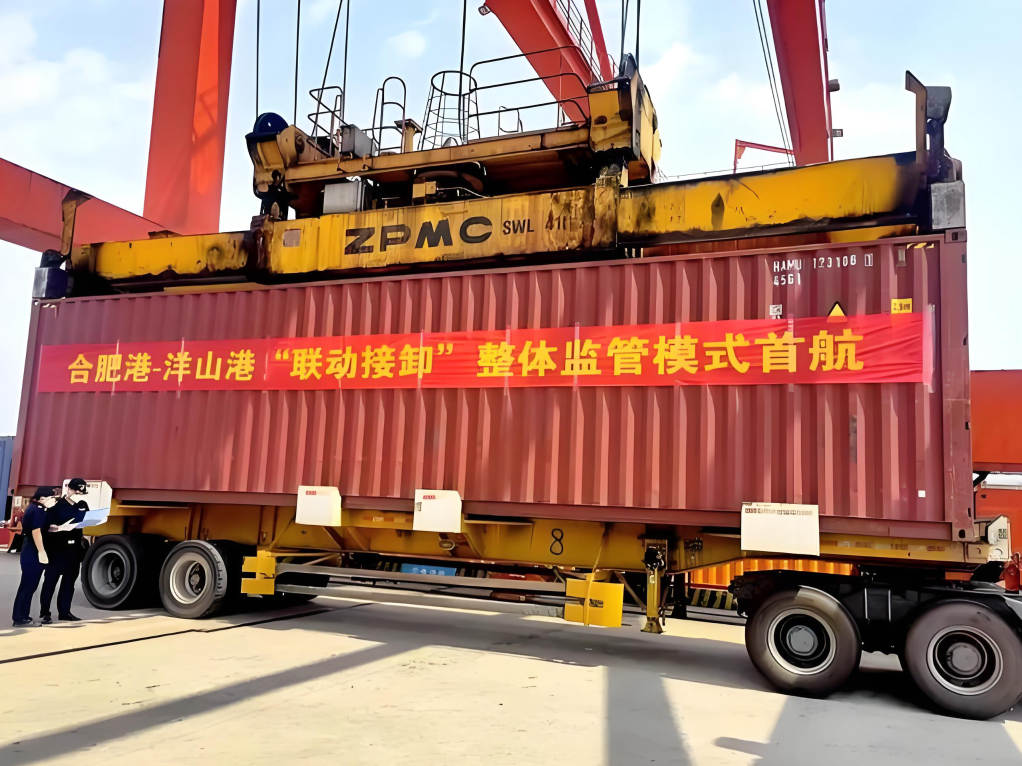
The picture shows the Yangtze River Delta Customs working together to supervise and coordinate the unloading mode of container transportation. (Image provided by Shanghai Customs)
Shanghai Yangshan Port is one of the hub ports in the Yangtze River Delta. In recent years, Shanghai Customs, together with Nanjing, Hangzhou, and Hefei Customs, has continued to promote the linkage unloading mode of "water water direct connection, multi port interaction, inland river undertaking, and Yangshan loading and unloading". Currently, it has covered the Yangtze River Delta region and 15 surrounding ports, forming an integrated operation pattern of "hub port leading, branch port coordinating, and inland river port supporting". In the first 11 months of this year, 485000 TEUs of imports and exports were completed in this model, which effectively reduced the logistics costs of related enterprises and improved the overall competitiveness of the Yangtze River Delta port group.

The picture shows the business site of "Shanghai Airport Suzhou Pre Cargo Terminal". (Image provided by Shanghai Customs)
In April of this year, the first cross provincial aviation pre cargo terminal in China, the "Shanghai Airport Suzhou Pre cargo Terminal," was officially put into use. This mode "moves forward" the customs supervision service. Enterprises can complete customs inspection in Suzhou Industrial Park. Under the full intelligent monitoring of the customs supervision platform, goods can be loaded and shipped directly to Shanghai Airport. Compared with the conventional customs clearance mode, the logistics time can be saved by 12 to 24 hours, and the enterprise cost can be saved by 10% to 30%. At present, about 387 shipments worth 21 million US dollars have been exported to 37 countries and regions around the world through the front-end cargo terminal mode
Traditional industries such as large-scale equipment manufacturing and petrochemicals are the "ballast stones" of the Yangtze River Delta economy. In the field of shipbuilding, Shanghai, Nanjing, and Hefei Customs have followed the trend of group operation of large shipping companies in the region, jointly promoting the bonded supervision mode of enterprise groups, supporting enterprises to conveniently allocate and use bonded materials within the group, and providing guarantees for the smooth delivery of fifth generation liquefied natural gas transport ships and other ship products.

The picture shows the Yangtze River Delta Customs carrying out bonded fuel cross-border direct supply business. (Image provided by Shanghai Customs)
In the field of energy security, Hangzhou Customs, together with Shanghai and Ningbo Customs, has established a "through train" for oil supply ships. Oil supply enterprises only need to declare once to the customs of the place of origin for oil storage, and then load the oil onto the tanker to directly supply oil to the ship at the receiving location. In the first 11 months of this year, the Yangtze River Delta Customs conducted a total of 3.7011 million tons of bonded fuel cross-border direct supply business, a year-on-year increase of 4.3%.
The import and export of vacuum packaged goods by high-tech enterprises such as integrated circuits can easily affect product performance and quality when opened and inspected in a normal port environment. To solve this problem, the five major customs in the Yangtze River Delta region have jointly promoted the optimization and upgrading of the "high-tech goods control and inspection mode", allowing enterprises registered in the Yangtze River Delta region to freely choose the import destination customs within the region, enabling high-tech goods to reach the production and research and development front line faster.
The vacuum packaging intelligent network backup platform, led by Hefei Customs, helps enterprises in the Yangtze River Delta to handle filing business online in real-time, greatly improving efficiency. At present, this model has covered 239 enterprises in the Yangtze River Delta region, and the time for customs clearance and inspection is more than 40% shorter than before.
Customs statistics show that since the beginning of this year, there have been over 46000 verified and trustworthy supply chains in the Yangtze River Delta region, which have helped goods worth 81.7 billion yuan enjoy convenient measures such as reducing customs control and inspection, and improved the stability and resilience of the industrial and supply chains in the Yangtze River Delta. (Reporter Wu Yu)
Editor: Jiang Yani
Related articles
-
Xinhua Commentary: China's first national conference on service sector boosts confidence in high-quality growth
-
Tennis transforms small county in east China
-
Xinhua Headlines: China, Laos boost energy ties with new 500-kV cross-border power link
-
China's homegrown quantum computer gains AI capabilities
-
NEVs drive Shanghai's auto export boom in Q1
-
Tourism boosts spring economy during Qingming Festival holiday
-
China reports vibrant consumption growth during Qingming Festival holiday
-
China's BYD seizes oil-driven EV momentum with win-win global push